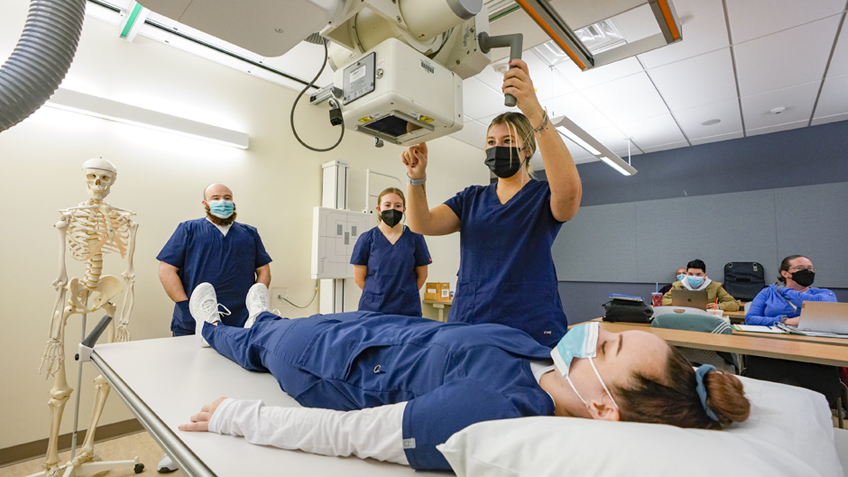
The Radiologic Technology Program trains students to perform diagnostic imaging procedures using ionizing radiation to aid in the diagnosis and treatment of disease. Students learn radiographic positioning, anatomy, physics, radiation protection, and image evaluation through a structured blend of classroom and clinical education.
SUI emphasizes hands-on skill development from the beginning. Students practice positioning and exposure techniques in our on-campus X-ray lab before entering clinical rotations. By the time they reach the clinical phase, they are confident in patient communication, radiation safety practices, and producing high-quality diagnostic images under supervision.
Clinical experiences take place in hospitals, urgent care facilities, and outpatient imaging centers, where students gain exposure to general radiography, fluoroscopy, trauma imaging, and surgical procedures.
Meet the Team
Bianca Bae, MS, R.T.(R)(MR)
Program Director
Bianca Bae began her career as a Limited X-ray Technician before earning her full radiography license and later cross-training into Magnetic Resonance Imaging (MRI), where she also became licensed.
She began her journey in 2015 as a student at her clinical site, where her commitment and skill led her to become the lead technologist, mentoring students and new technologists. This path shaped her passion for education and ultimately led her to her current role as Program Director of the Radiologic Technology Program at Sacramento Ultrasound Institute, where she brings a full-circle perspective, understanding both the student experience and clinical site demands.
Bianca holds a Master’s Degree in Human Resources Development from the University of Bucharest.
Her teaching philosophy is grounded in empathy and perseverance, believing that “If there’s a will, there’s a way.” She is dedicated to guiding students with structure, compassion, and real-world insight as they grow into confident imaging professionals.
LinkedIn profile
Scott Wilson, MBA, RT(R)(CT)
Clinical Coordinator
W. Scott Wilson, RT(R)(CT), brings more than three decades of experience in radiologic technology, advanced imaging, and medical imaging education. He holds an MBA in Leadership from Trident International University, a BA in Business Management from St. Mary’s College, and an AS in Radiologic Technology from Fresno City College. Scott’s clinical background includes extensive work as a radiographer at Sutter Medical Foundation, Sierra Nevada Memorial Hospital, and San Bernardino Community Hospital, where he performed CT, angiography, trauma imaging, portable radiography, and C-arm procedures.
Scott has spent much of his career in higher education, serving as a medical imaging instructor at Yuba College, Merritt College, and Mesa College. His experience includes teaching all levels of medical imaging, developing online and hybrid courses—including the first CT course at Merritt College—coordinating clinical education, overseeing compliance with state and national regulations, and supporting student success through evaluation and mentorship. With a long history of instruction and clinical leadership, Scott brings a strong commitment to high-quality training in radiologic and advanced imaging sciences.
Kaitlyn Grove, R.T. (R)
Faculty
Kaitlyn Grove, R.T. (R), serves as one of the faculty for the Radiologic Technology program at SUI. With over 2 years of experience in radiology and healthcare, she has developed a strong foundation in diagnostic imaging and patient care. Kaitlyn holds a Bachelor of Science in Radiologic Science from East Tennessee State University where she graduated Summa Cum Laude. She is credentialed as a Registered Radiologic Technologist by the American Registry of Radiologic Technologists. Kaitlyn is dedicated to fostering a love of learning and supporting her students so they can excel in their future careers in radiology.
Clinical Training
After completing foundational coursework and extensive lab practice, SUI students begin clinical rotations at partnering hospitals and imaging centers across California.
By this stage, students have mastered radiographic positioning, exposure technique, radiation protection, and image evaluation. During clinical rotations, they apply these skills to perform general diagnostic imaging procedures under the supervision of credentialed radiologic technologists.
Each rotation reinforces technical precision, patient care, and professionalism through direct, supervised experience. Students rotate through multiple imaging areas — including general radiography, trauma, surgery, and fluoroscopy — to gain exposure to a variety of patient populations and imaging environments.
SUI’s Clinical Coordination Team works with each partner site to ensure smooth scheduling and communication. Typical rotations align with 32–40 clinical hours per week, with documentation and progress tracking maintained through the Trajecsys Clinical Tracking System.
Labs & Equipment
SUI’s on-campus radiography lab provides students with hands-on experience using two fully functional digital X-ray units, giving them the opportunity to practice in a realistic, professional environment.
One of these units is shared with SUI’s partner company, Sacramento Imaging, an operational diagnostic imaging center. This collaboration allows students to observe the real-time flow of patients, experience live imaging procedures, and understand how radiography integrates into daily clinic operations.
Under the supervision of credentialed radiologic technologists, students practice:
Radiographic positioning and alignment across all body regions
Digital image acquisition and evaluation
Radiation safety and exposure optimization
Patient communication and professionalism during exams
Lab sessions are limited to 12 students per instructor, ensuring individualized instruction and immediate feedback.
This early exposure to an active imaging workflow helps students transition smoothly into clinical rotations — confident, competent, and fully prepared for the pace of hospital and outpatient settings.
What SUI Provides
SUI is committed to ensuring that every partnership is smooth, well-supported, and beneficial for both the facility and the students.
As a CAAHEP-accredited program, SUI awards up to 6.0 SDMS CME credits per year to qualified clinical instructors for providing student instruction. This benefit allows clinical educators to earn recognized continuing education credit while mentoring the next generation of sonographers.
SUI students enter clinical rotations having already demonstrated competence in scanning healthy patients and understanding sonographic anatomy. They’re confident, professional, and ready to contribute from day one.
Each clinical partner is supported by a dedicated SUI Clinical Coordinator who manages student placement, onboarding documentation, and ongoing communication throughout the rotation. Coordinators visit the site during the first week of a new student’s onboarding to ensure a smooth start, and return for monthly in-person visits to support both students and staff. They also oversee Trajecsys, ensuring students are clocking in correctly, logging progress accurately, and maintaining compliance with program requirements.
Credentialed faculty continuously monitor student performance to align clinical training with program objectives and accreditation standards, ensuring consistency and quality across all sites.
SUI maintains open communication with every clinical partner through routine check-ins, progress evaluations, and responsive follow-up whenever concerns arise. Our goal is to provide full transparency and proactive problem-solving throughout each rotation.
SUI values every clinical partner and highlights participating sites through institutional materials, community outreach, and collaborative initiatives that showcase their contribution to student success.
What Clinical Partners Provide
Our clinical partners are essential to the success of SUI’s Radiologic Technology program. By opening their departments to students, they help bridge the gap between classroom instruction and professional practice.
We ask partners to:
Provide a safe and professional imaging environment where students can perform radiographic procedures under supervision.
Designate a qualified radiologic technologist or lead instructor to guide students, provide feedback, and verify competencies.
Allow students to observe and assist with general diagnostic imaging, surgical, and trauma cases as appropriate to the site’s scope of practice.
Reinforce radiation safety, patient care, and communication standards throughout clinical training.
Verify attendance, evaluations, and progress through Trajecsys, SUI’s secure clinical tracking system.
SUI’s faculty and coordinators provide full administrative and academic support, ensuring that partnerships are well-coordinated, compliant, and easy to manage.
What our Partners Say about us
“SUI students arrive prepared and ready to scan from day one. Their professionalism and confidence make them a great fit for our fast-paced environment.”
Lead SonographyMercy General
“Working with SUI’s clinical coordinators has been seamless. They’re responsive, organized, and always available when we need support.”
Clinical SupervisorSutter Woodland
No one reads these
John DoeCEO
Trajecsys
SUI uses the Trajecsys Clinical Tracking System, a secure online platform that allows students, clinical instructors, and program faculty to record and monitor clinical activity in real time. Through Trajecsys, instructors verify attendance, log competency evaluations, and submit performance feedback. This system ensures complete transparency and accountability, allowing SUI’s clinical coordinators to track student progress, hours, and case experience remotely while maintaining compliance with accreditation standards.
Documents & Resources
Clinical Handbook
Get More Info
We’re always looking to expand our clinical partnerships and welcome new sites that share our commitment to quality education and patient care.
If your facility is interested in becoming a partner or learning more about our programs, please complete the form below — our Clinical Coordination Team will reach out to you directly.