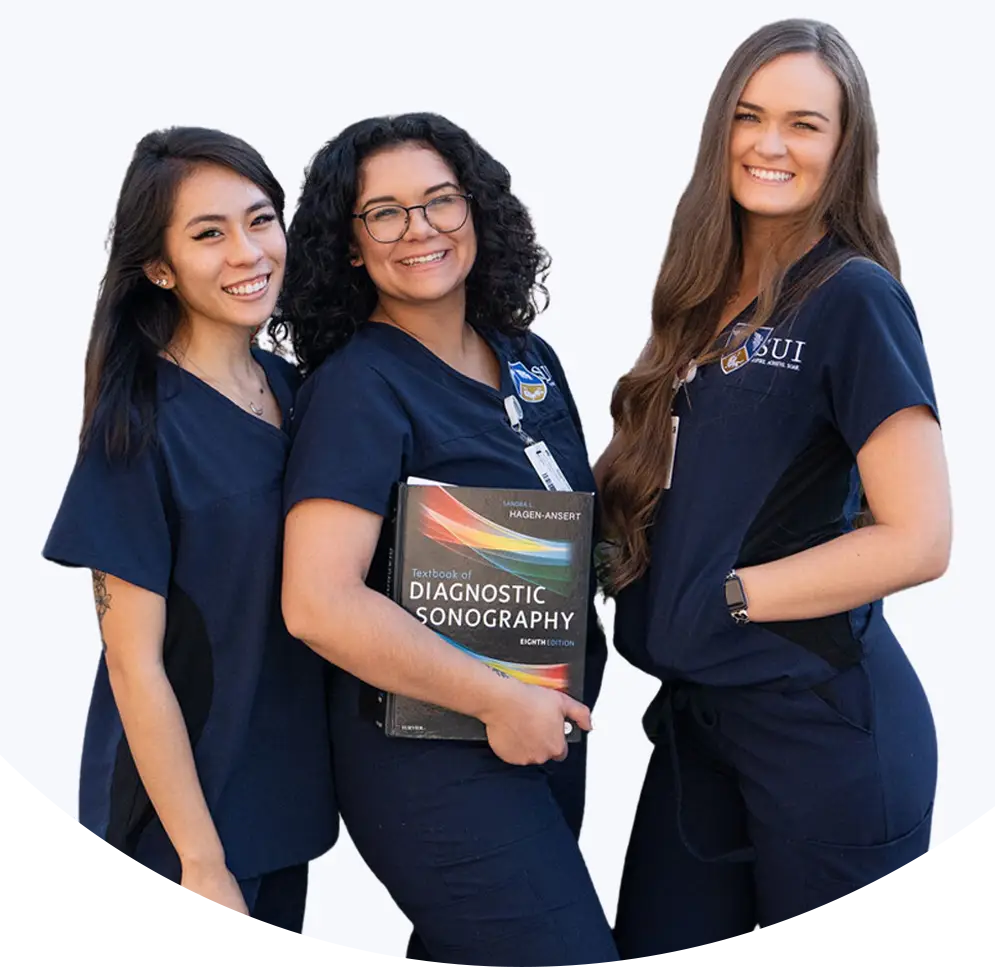
Welcome to the Invasive Cardiovascular Technology (CVT) Program at Sacramento Ultrasound Institute, where we prepare students to become skilled members of the cardiac catheterization team.
Our program combines rigorous classroom instruction with hands-on training to develop professionals who are confident, technically proficient, and patient-focused. Students learn the essential skills needed to support diagnostic and interventional cardiac procedures while maintaining the highest standards of safety and collaboration.
Program Overview
The Invasive Cardiovascular Technology Program at SUI trains students to assist physicians during diagnostic and therapeutic heart procedures such as cardiac catheterizations, angioplasties, and stent placements.
Students gain a strong foundation in cardiac anatomy, physiology, hemodynamics, and ECG interpretation. Through classroom learning, lab practice, and clinical experience, they learn to operate specialized cath lab equipment, monitor patients during procedures, and maintain sterile fields under pressure.
Before entering clinical rotations, students complete intensive lab simulations where they practice catheterization techniques, table setup, equipment operation, and teamwork under realistic conditions. By the time they reach the clinical phase, they are ready to integrate smoothly into cath lab environments and support patient care with confidence and professionalism.
CAAHEP Accredited
Since 2023, the Cardiac Sonography (CS) program has been programmatically accredited by the Commission on Accreditation of Allied Health Education Programs (CAAHEP), upon the recommendation of the Joint Review Committee on Education in Cardiovascular Technology (JRC-CVT).
Meet the Team
Lee Ann Johnson, M.Ed, RCIS
Program Director
Lee Ann Johnson, MH Ed, RCIS, serves as the Program Director for the Invasive Cardiovascular Technology program at SUI. With over 25 years of experience in cardiovascular education and healthcare, she has directed and developed multiple programs across academic and clinical settings. Lee Ann previously led the Cardiovascular Invasive and Electrophysiology programs at the Pennsylvania College of Health Sciences, expanding clinical partnerships and raising national exam pass rates. She has also authored more than 40 vascular procedure curricula integrating medical simulation for hospitals and universities worldwide.
Lee Ann holds a Master’s in Adult Education from Capella University and is credentialed as a Registered Invasive Cardiovascular Specialist. She is dedicated to fostering innovation and excellence in cardiovascular education.
LinkedIn profile
Edin Mandzukic, RCIS
Clinical Coordinator
Edin Mandzukic is a Registered Cardiovascular Invasive Specialist (RCIS) with more than twenty years of experience in patient care and interventional cardiology. He completed his training through the CAAHEP/JRC-CVT accredited Invasive Cardiovascular Technologist Program at Carnegie Institute in Troy, Michigan. Edin has worked in RCIS roles at Crittenton Hospital and Sparrow Hospital, contributing to cardiac cath lab operations and interventional procedures.
Before entering the invasive cardiology field, Edin spent many years in direct patient care as a Patient Care Technician and Nursing Assistant across the Henry Ford, St. John, and McLaren health systems. He completed externships at Henry Ford Macomb, St. Joseph Mercy Pontiac, and Sparrow Hospital, further strengthening his clinical background. Edin holds BLS and ACLS certifications through the American Heart Association and brings a strong commitment to teamwork, patient support, and high-quality cardiovascular care.
LinkedIn profile
Clinical Training
After completing intensive didactic and simulation-based instruction, SUI students begin clinical rotations in cardiac catheterization labs and interventional cardiology departments across California.
By this stage, students have a strong understanding of hemodynamics, sterile technique, ECG interpretation, and cardiovascular anatomy. They are trained to assist with diagnostic and interventional procedures such as angiograms, angioplasties, and stent placements, and to monitor patients before, during, and after procedures.
Each rotation emphasizes team-based care, procedural accuracy, and patient safety. Students learn to prepare procedure tables, operate imaging equipment, maintain sterile fields, and assist in managing patient monitoring systems.
SUI’s Clinical Coordination Team collaborates with every site to align rotation schedules and ensure seamless onboarding. Clinical rotations typically run 32–40 hours per week, and coordinators maintain communication with preceptors throughout the placement to provide academic and administrative support.
Labs & Equipment
SUI’s Invasive Cardiovascular Technology lab provides students with a safe, structured environment to develop the core skills required for success in the cardiac catheterization lab.
The facility includes two fully equipped simulation stations that replicate real-world cath lab workflows. Each station allows students to practice team-based communication, procedural setup, and technical skills using realistic equipment and clinical scenarios.
Training focuses on:
Fluoroscopy table simulation and procedural setup
Sterile field maintenance and instrument handling
Catheterization and wire manipulation techniques (simulated)
Hemodynamic and ECG monitoring practice
Radiation safety and patient positioning
Emergency response simulations and teamwork exercises
All training is conducted under the supervision of credentialed faculty and maintains a 12:1 student-to-instructor ratio for individualized feedback.
These simulation sessions prepare students to transition confidently into real cath lab environments — ready to work safely, communicate effectively, and understand their role in the interventional cardiology team.
What SUI Provides
SUI is committed to ensuring that every partnership is smooth, well-supported, and beneficial for both the facility and the students.
As a CAAHEP-accredited program, SUI awards up to 6.0 SDMS CME credits per year to qualified clinical instructors for providing student instruction. This benefit allows clinical educators to earn recognized continuing education credit while mentoring the next generation of sonographers.
SUI students enter clinical rotations having already demonstrated competence in scanning healthy patients and understanding sonographic anatomy. They’re confident, professional, and ready to contribute from day one.
Each clinical partner is supported by a dedicated SUI Clinical Coordinator who manages student placement, onboarding documentation, and ongoing communication throughout the rotation. Coordinators visit the site during the first week of a new student’s onboarding to ensure a smooth start, and return for monthly in-person visits to support both students and staff. They also oversee Trajecsys, ensuring students are clocking in correctly, logging progress accurately, and maintaining compliance with program requirements.
Credentialed faculty continuously monitor student performance to align clinical training with program objectives and accreditation standards, ensuring consistency and quality across all sites.
SUI maintains open communication with every clinical partner through routine check-ins, progress evaluations, and responsive follow-up whenever concerns arise. Our goal is to provide full transparency and proactive problem-solving throughout each rotation.
SUI values every clinical partner and highlights participating sites through institutional materials, community outreach, and collaborative initiatives that showcase their contribution to student success.
What Clinical Partners Provide
Our clinical partners are vital to the success of SUI’s Invasive Cardiovascular Technology program. By providing hands-on learning opportunities in real cardiac catheterization environments, they help students transition from simulation to live procedural practice.
We ask partners to:
Provide a safe and collaborative clinical environment for students to observe and assist during cardiac procedures under direct supervision.
Designate a qualified cardiovascular technologist, nurse, or physician preceptor to oversee daily training and verify competencies.
Allow students to participate in diagnostic and interventional procedures such as angiograms, angioplasties, and stent placements, appropriate to their skill level.
Reinforce radiation safety, sterile field integrity, and patient monitoring standards at all times.
Verify attendance, competencies, and evaluations through Trajecsys, SUI’s secure online clinical tracking system.
SUI’s faculty and coordinators ensure every placement is organized, compliant, and supported — making the process straightforward for both students and clinical sites.
What our Partners Say about us
“SUI students arrive prepared and ready to scan from day one. Their professionalism and confidence make them a great fit for our fast-paced environment.”
Lead SonographyMercy General
“Working with SUI’s clinical coordinators has been seamless. They’re responsive, organized, and always available when we need support.”
Clinical SupervisorSutter Woodland
No one reads these
John DoeCEO
Trajecsys
SUI uses the Trajecsys Clinical Tracking System, a secure online platform that allows students, clinical instructors, and program faculty to record and monitor clinical activity in real time. Through Trajecsys, instructors verify attendance, log competency evaluations, and submit performance feedback. This system ensures complete transparency and accountability, allowing SUI’s clinical coordinators to track student progress, hours, and case experience remotely while maintaining compliance with accreditation standards.
Documents & Resources
Clinical Handbook
Get More Info
We’re always looking to expand our clinical partnerships and welcome new sites that share our commitment to quality education and patient care.
If your facility is interested in becoming a partner or learning more about our programs, please complete the form below — our Clinical Coordination Team will reach out to you directly.